- Languages :


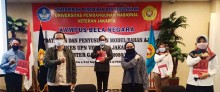
FIKES UPNVJ - Depok, October 1, 2025 — As a form of commitment to realizing a healthy and environmentally conscious society, the Public Health Study Program, Faculty of Health Sciences, Universitas Pembangunan Nasional “Veteran” Jakarta (UPNVJ) held an activity “Waste Management Education and Demonstration of the Takakura Method” at the Al Amin Prayer Room, RW 9, Cipayung Village, Cipayung District, Depok City. This activity was accompanied by Dr. Hj. Een Kurnaesih, S.K.M., M.Kes. and Dr. Yunita Amraeni, S.K.M., M.Kes., along with UPNVJ Public Health students, as part of the community service program. The target of the activity was residents of RW 9, including housewives, health cadres, environmental administrators, and youth from the youth organization. “The waste problem is a major challenge in urban areas. Through this education, we want to instill awareness and skills in the community to manage waste from its source independently,” said Dr. Hj. Een Kurnaesih.
This interactive event included a lecture on the importance of household waste management, an introduction to the 3R concept (Reduce, Reuse, Recycle), and a live demonstration of composting using the Takakura method. This method was introduced as a simple and environmentally friendly technique for processing household organic waste into useful compost. Participants enthusiastically participated in each stage of the workshop, from preparing the Takakura baskets, making the starter, to mixing the organic waste. Many residents admitted they had just learned that food, fruit, and vegetable scraps can be easily processed into natural fertilizer without producing odor. "The Takakura method not only reduces waste volume but also provides economic and environmental benefits. We hope people will implement it in their homes," added Dr. Yunita Amraeni, a lecturer in Public Health.
The evaluation results of the activity showed an increase in community knowledge. Based on pre- and post-test results, all participants (100%) demonstrated good knowledge after participating in the training, with an average score increasing from 92 to 95.5. This indicates that the educational activities and hands-on practice have successfully strengthened community understanding of the importance of sustainable waste management.
The activity concluded with a discussion session, distribution of educational leaflets, and documentation with residents. The team of lecturers and students also plans to provide follow-up assistance to monitor the sustainability of the Takakura method at the household level. Through this activity, UPNVJ hopes to continue contributing to building environmental awareness in urban communities, while also supporting the national waste management program and achieving the Sustainable Development Goals (SDGs), particularly in the areas of sustainable cities and settlements (SDG 11) and responsible production and consumption (SDG 12).
Daftar sekarang untuk menerima berita terkini, lowongan kerja, dan informasi lainnya.