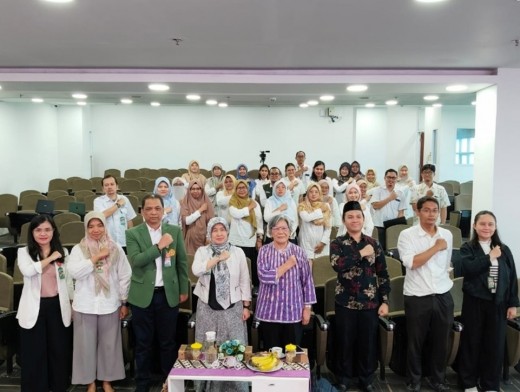
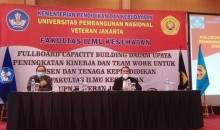
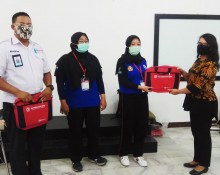
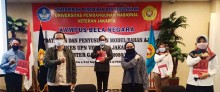
FIKES UPNVJ - Jakarta, October 20, 2025 — The Undergraduate Public Health (Kesmas) Study Program, Faculty of Health Sciences (FIKES) of UPN "Veteran" Jakarta (UPNVJ), kicked off the Vision, Mission, Goals, Targets (VMTS), and Curriculum Review Workshop on Monday, October 20, 2025, at the 8th Floor of the MERCe Building, Limo Campus. This two-day workshop follows up on the ASIIN international accreditation recommendations and strategic efforts to integrate renewable public health competencies in accordance with national curriculum guidelines and existing challenges, as well as strengthen efforts to identify areas of excellence that can become the program's distinctive characteristics.
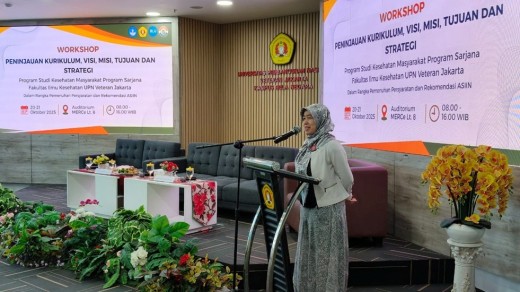
In her opening remarks, the Dean of the UPNVJ Faculty of Health Sciences, Desmawati, SKP, MKep, Sp.Mat, PhD, expressed the faculty's full commitment to the VMTS and curriculum review process. She emphasized that this step is not merely a formality, but a strategic necessity to ensure UPNVJ graduates remain relevant and competitive. It also represents a concrete step in supporting the internationalization program and following up on ASIIN recommendations.
The event, attended by faculty leaders, the entire curriculum review team, and several key stakeholders from the Association of Indonesian Public Health Higher Education Institutions (AIPTKMI), the Depok City Health Office, the Cinere Community Health Center, and the University of Indonesia Hospital (RSUI), focused on aligning the curriculum with the needs of the workplace, the latest national regulations, and local, national, and global public health challenges.
Alignment with National Regulations and the Global Framework
In his presentation, Satria Yudhia Wijaya, SE., MS., AK. from the UPNVJ Quality Assurance and Learning Development Institute (LPMPP) emphasized the importance of a future-oriented, memorable, and specific vision. He also highlighted the implementation of National Defense and international standards that must be reflected in the Strategic Plan and curriculum documents.
Prof. Dr. dr. Sabarinah Prasetyo, M.Sc., an expert resource person from AIPTKMI, explained the VMTS process, which must be aligned from the university down to the study program. "The curriculum must be outcome-based and implement student-centered learning, where lecturers act as facilitators. Assessments must be analytical, not simply memory tests," she emphasized. Prof. Sabarinah also explained the competency framework for professional public health workers according to AIPTKMI and WHO 2024, as well as the flexibility in adjusting the 20 credits of elective courses.
Concrete Input from Stakeholders
Focus Group Discussions (FGDs) with external stakeholders yielded several inputs for the curriculum:
Dr. Mutmainah Indriyati, MKM (Depok City Health Office) highlighted the need for practical data analysis competencies, effective communication that adapts to local culture, and digital literacy to manage stunting data and other health programs. "Students need to be able to perform data cleaning, area-based analysis, and persuasive data storytelling for advocacy," she explained.
Dr. Astrid Saraswaty Dewi, M.A.R.S. (RSUI) emphasized the importance of building a professional portfolio early on and mastering digital tools like Canva, CapCut, and Google Data Studio, in addition to soft skills like the 5S work ethic.
Drg. Rahmina Dewi (Cinere Community Health Center) expects graduates to be proficient in field epidemiology, digital health promotion, and data analysis. She recommended increasing local case studies, extending the internship duration, and involving students in advocacy simulations with stakeholders.
Through the first day of the workshop, the UPNVJ Public Health Study Program reinforced its commitment to creating a responsive curriculum that not only meets academic standards but also addresses real-world challenges.